

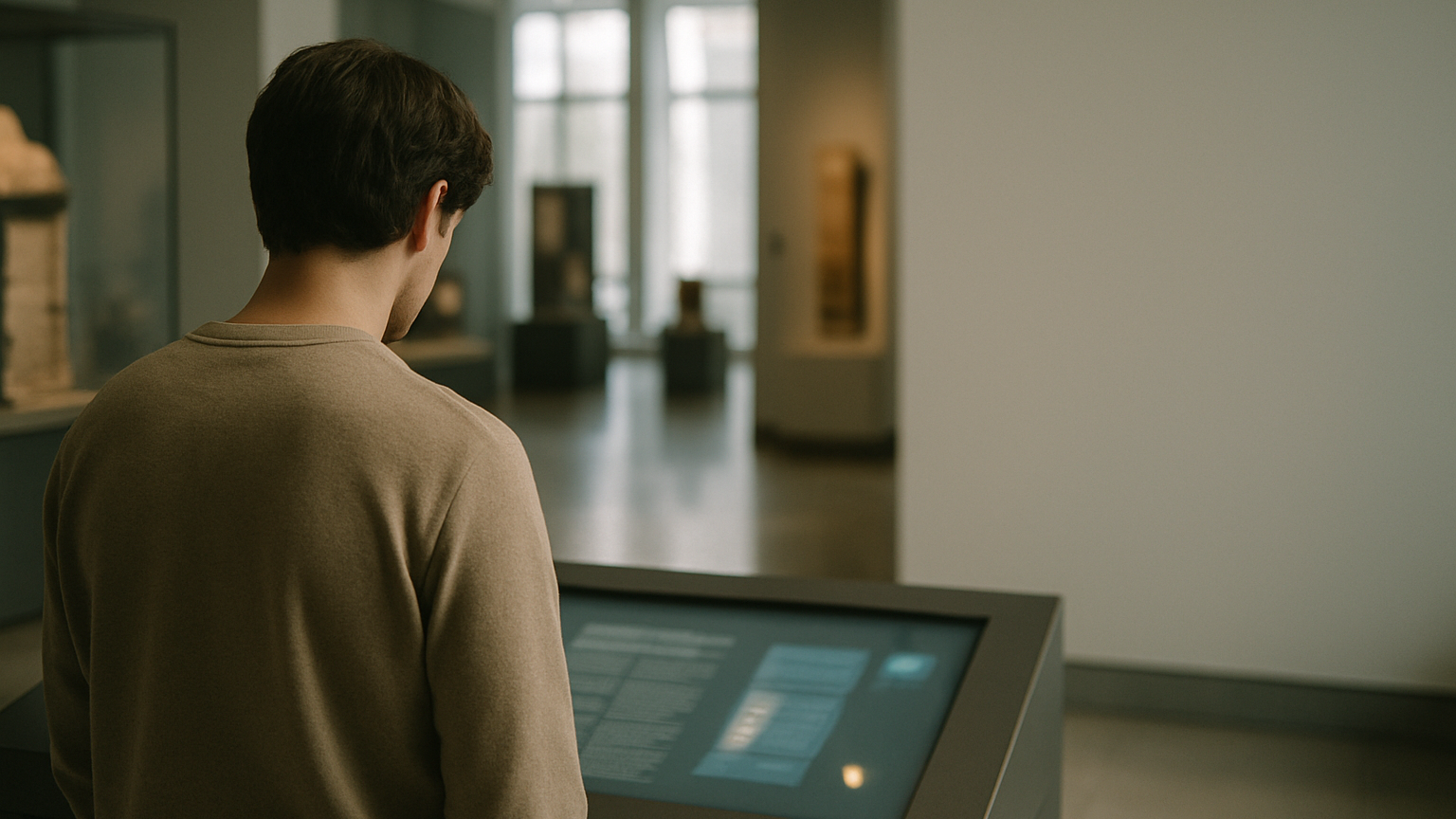
People don’t remember plaques. They remember how a space made them feel, what it nudged them to do, and the story they told themselves on the way out. That’s why immersive museum experiences are powerful engines for brand awareness. They don’t just deliver information; they choreograph moments that attach to memory and then travel into the world as word‑of‑mouth, photos, and habits. When a brand shows up inside that choreography—subtly, consistently, and with taste—it becomes the anchor people use to file the whole experience. That’s the difference between an exhibit you saw and a brand you carry with you.
Imagine a visitor stepping across a threshold as the lighting warms, a soundscape swells, and a choice appears: explore, co‑create, or sit and listen. That moment of agency, multiplied across a journey, forms a story the visitor now owns—and brands that enable it are remembered as guides, not megaphones. In practice, most visitors recall one surprising beat and the feeling they had in it, then retell that feeling to friends with your brand as the shorthand. This is how awareness snowballs without shouting. No fluff, just outcomes.
Why Immersive Spaces Are Brand Builders, Not Just Exhibits
First, immersive spaces compress distance between message and meaning. Instead of reading about a concept, you feel it underfoot, in the air, and through a decision you make. That multisensory cue stack creates a deeper encoding pathway, which is exactly what brand awareness needs: repeated, coherent signals that resolve into identity. Second, when the environment gives visitors roles—explorer, maker, archivist—the brand becomes a collaborator in that identity play, not just a logo on a wall. Third, the exit is a launchpad: people leave with a story worth retelling, which is the cleanest form of earned reach.
Done well, the space has a narrative spine and a set of brand codes—tone, materials, typography, sonic motifs—that show up consistently but never overpower the content. You can build those codes into wayfinding, lighting transitions, interaction patterns, even the micro‑copy at decision points. The result feels inevitable rather than forced, which protects credibility while amplifying recall. If you need a partner who treats this like product design—strategy first, craft second, tech in service of both—work with a creative software agency that understands environments as systems.
Who shouldn’t invest in this? If you want a quick selfie booth and a weekend spike, skip it. If your approval culture can’t iterate on prototypes, the process will frustrate you. And if your brand must remain invisible for curatorial reasons, consider lighter‑touch interpretive layers instead of full immersion. The point is alignment: when the story, the institution’s mission, and the brand promise meet, visitors feel the integrity—and remember it.
What Makes immersive museum experiences Stick In Memory
Immersive museum experiences stick because they orchestrate novelty with meaning. Distinctiveness opens the door—unexpected scale, an impossible perspective, a tactile interface—but coherence invites you to stay. Each room or zone should resolve a question and open a new one, building a rhythm of curiosity and closure that the brain loves. Layer a simple emotional arc on top—wonder to understanding, tension to relief—and people will summarize it later in one clear sentence your brand can live inside.
Agency matters more than spectacle. When visitors make a choice that changes what they see or hear, the outcome becomes personal, and personal stories get retold. That’s why even small interactions—turning a dial that remixes a historic speech, choosing a path that reframes a timeline—can outrun big projections in long‑term recall. The visitor’s micro‑victory becomes your macro‑awareness.
Finally, transition moments do heavy lifting. Thresholds, resets, and breathers are where visitors orient, check in with companions, and snap photos. Place your brand codes subtly here—materials, iconography, sound cues—so they reinforce identity without hijacking the narrative. You’ll earn recognition every time a phone comes out and a caption gets written.
From Story To Space: Designing For Emotion, Flow, And Recall
Start with a one‑sentence story promise. Then map it to space: a clear beginning (orientation and invitation), a middle (choice and consequence), and an end (reflection and shareability). Designing immersive museum experiences is less about adding tech and more about removing friction—simplifying choices, clarifying thresholds, and pacing the journey so visitors never feel rushed or stuck. When the path feels intuitive, attention is free to connect dots, which is where meaning—and brand memory—forms.
Build sensory hierarchies per zone. If sound leads, keep visuals clean; if haptics lead, quiet the soundtrack; if story text leads, warm the light and lower contrast around it. These hierarchies prevent cognitive overload while giving your brand codes room to breathe. In practice, most teams find that subtracting one sensory element per room improves dwell time and comprehension.
Be honest about constraints. Conservation rules, accessibility needs, staffing realities, and throughput targets shape the canvas as much as creative ambition. If you need strict neutrality or a purely archival presentation, don’t force a branded layer—use restrained design and let credibility be the hero. But if your mission includes public engagement and education, aligning the space’s emotional beats with your brand’s promise is not decoration; it’s delivery.
AR And VR That Serve The Story, Not The Hype
Augmented reality excels at layering context on artifacts and architecture without breaking presence. It’s perfect for spatial annotations, time‑shift overlays, and multilingual interpretation that respects conservation boundaries. Virtual reality, by contrast, is a portal: step in, leave the gallery, and visit a reconstructed site or an impossible scale model. Use AR to deepen here, VR to transport there—both should pay rent in the story.
Hardware choices are strategy choices. Handheld AR keeps groups together and encourages shared discovery; headset AR increases precision but can fragment parties; room‑scale VR creates peak moments but requires throughput choreography. Prototype early with real visitors, not just the core team, and instrument those prototypes to learn where guidance, comfort, and clarity need work. If tech is the headline, the story is already lost.
Above all, integrate your digital layers with the operational backbone—ticketing, maintenance, cleaning, and updates—so brilliance on day one doesn’t fade by month three. After a few weeks, one issue usually comes up: maintenance. Plan content pipelines, device rotation, and analytics from the start or you’ll end up flying blind. And when you need specialists who build for reliability as much as wow, lean on partners experienced in AR / VR Development that’s aligned with narrative goals.
Proving The Brand Impact: Metrics That Matter To The C‑Suite
Great experiences feel inevitable, but budgets don’t. To secure and sustain investment, translate delight into numbers executives trust. That means separating vanity metrics from signal, combining qualitative insight with quantitative proof, and benchmarking before launch so lift is actually measurable. Treat the experience like a product: instrument, analyze, iterate.
A simple model helps: brand effects, on‑site behaviors, and off‑site amplification. Each category ties to a different business conversation—awareness and perception, operational performance, and reach beyond the walls. When teams agree on these pillars early, design decisions get clearer and post‑launch debates get shorter. Everyone knows what success looks like and where to look for it.
Brand Lift, Awareness, And Consideration
Run pre/post surveys with both aided and unaided recall to see whether visitors name your brand and describe it with the attributes you intend. Pair that with sentiment coding from exit interviews to spot the narrative fragments they carry out. Track changes in brand consideration among target segments who attended versus those who didn’t. The goal isn’t just to be remembered—it’s to be remembered for the right reasons.
On-Site Behaviors: Dwell Time, Heatmaps, Repeat Visits
Instrument the journey with anonymous sensors to measure dwell time per zone and path choices between them. Heatmaps will show where attention concentrates and where friction causes drop‑off, which is gold for iteration. Tie repeat visits to membership or ticket IDs to understand which narrative beats earn return behavior. If certain interactions consistently create longer stays and smiles, you’ve found a brand‑positive moment to scale.
Social Amplification: UGC, PR, And Community Partnerships
Design for shareability without designing for spectacle alone. Calibrate one or two photogenic thresholds where lighting, composition, and story cues make posting effortless, then monitor UGC volume and quality. Track earned media mentions and connect with schools, nonprofits, or local creators for co‑hosted events that extend reach authentically. When posts echo your narrative and reuse your brand codes, awareness compounds rather than diffuses.
Why Partner With RTE Global: 140 Projects, Strategic Creativity
RTE Global blends emerging technology with strategic and creative thinking to turn spaces into stories people remember. With 140 completed projects, we’ve learned how to prototype fast, test with real visitors, and harden concepts into reliable operations. That means your team isn’t choosing between bold ideas and day‑two resilience—you get both. And you get partners who treat your mission and brand promise like north stars.
Our teams collaborate across strategy, interaction, and engineering so the narrative and the system architecture reinforce each other. When a custom integration or backend is the right move, our approach to custom software development keeps data, content, and devices in sync. When a lightweight layer is smarter, we’ll say so and design for simplicity. Either way, the measuring plan ships with the experience, not after it.
If you’re exploring immersive museum experiences to build brand awareness, let’s align on outcomes first: what visitors should feel, what they should retell, and what the metrics should prove. Then we’ll design the journey that makes those outcomes likely and the stack that makes them maintainable. We aim higher than one‑week buzz—our bar is durable memory that moves your mission and brand forward. That’s the work.