

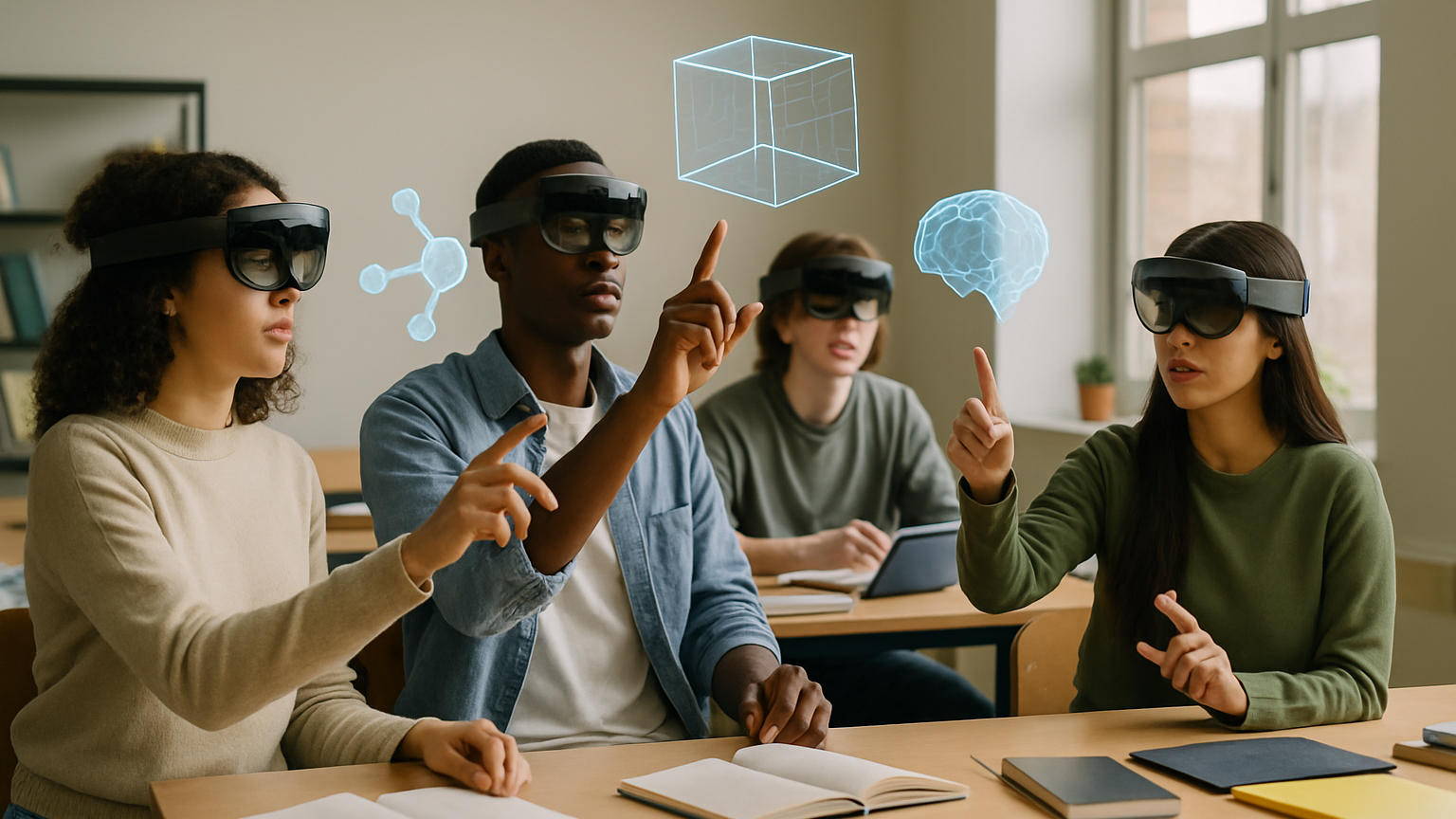
You don’t need another demo video; you need learning results you can defend. The promise of mixed reality in education isn’t just cool headsets—it’s safer labs, deeper understanding, and skills that transfer to the real world. When students can manipulate molecules, walk through a power plant, or interview an AI-driven patient, the lesson sticks because it’s lived, not just read. The trick is choosing where immersion beats slides and worksheets by a mile. In practice, most teams see the biggest lift when MR replaces a bottleneck—lab access, safety risks, rare events—rather than becoming one more thing to manage.
Mixed reality spans VR, AR, and devices that blend both—think room-scale simulations, tablet-based overlays, and optical headsets for hands-on tasks. Used well, it turns invisible concepts visible and risky procedures repeatable. If you’re mapping a path from pilot to scale, partnering with a seasoned creative software agency helps you avoid the usual pitfalls around content, data, and classroom flow. We’ve seen this across industries and regions—RTE Global operates in six countries and has completed 140 projects—so patterns emerge. Short version: pedagogy first, tech second, logistics always.
This approach won’t suit everyone. If your goal is a quick 10‑minute video and a quiz, MR is overkill—stick to what’s light and fast. But when your learners need to practice decisions, handle equipment, or visualize systems in 3D, immersion earns its keep. Real talk: the novelty wears off in about two weeks; what endures is a tight workflow that saves time and reduces errors. Let’s get specific about where it truly delivers.
Why Mixed Reality Belongs In The Classroom Now
Three forces are pushing classrooms toward immersion: safety, access, and attention. Labs and workshops are expensive and often oversubscribed; MR makes them available anytime without consumables or queues. Hybrid learning is here to stay, so experiences must travel well between home and campus—simulations do. In vocational and professional settings, solutions like RTE’s VRskills enable training without a physically present instructor, keeping cohorts moving even when schedules don’t align. That flexibility is gold when you’re juggling facilities, staff time, and learner availability.
The cost side is shifting too. A well-designed digital lab or maintenance simulation can run thousands of repetitions with no chemicals, broken parts, or cleanup. Content updates travel at the speed of software, not procurement cycles. You can prototype concepts in days, test them with a single class, and refine fast—far cheaper than building a new physical setup. When each iteration improves clarity or reduces an error, the compound interest on learning kicks in.
Of course, there’s friction. Motion sensitivity is real for a minority of learners, device hygiene needs a plan, and Wi‑Fi dead zones can torpedo a session. You’ll also want clear classroom choreography: who helps with headsets, how groups rotate, what early finishers do. This is not for you if there’s no time to rehearse facilitation or to brief IT on support. But with a simple playbook and a few trained champions, the bumps smooth out quickly.
Hardware and content ecosystems have matured—lighter headsets, better hand tracking, and cross‑platform engines make delivery far more practical than a few years back. The most resilient mixed reality use cases share three traits: they target a painful learning bottleneck, they provide immediate feedback, and they log data you can act on. When you design for those, novelty fades and mastery rises. That’s when faculty stop asking, “Will this work?” and start asking, “How do we get more scenarios?”
The Pedagogy Behind Immersive Learning That Sticks
Immersion works because it lines up with how people learn. Embodied cognition ties movement to memory, so manipulating a valve or assembling a circuit encodes knowledge more deeply than reading about it. Dual coding—pairing visuals with language—happens naturally in 3D spaces. And presence reduces distractions: when a learner is “inside” the model, the browser tabs disappear. You’re not just telling; you’re letting them do, decide, and see consequences.
Deliberate practice is the backbone. Good MR experiences chunk skills into short scenarios with clear goals and immediate feedback: correct the grip, recalibrate the sensor, try the dialogue again. Missed steps trigger just‑in‑time hints, not a wall of text. When learners loop through variations—different faults, new patient symptoms—they build flexible, transferable competence. That’s hard to achieve with static content.
Cognitive load matters. If you drop students into a complex cockpit with no scaffolding, they drown. Strong design introduces elements gradually, locks nonessential controls, and uses spatial cues to guide attention. Short sessions (8–15 minutes) prevent fatigue, and debriefs connect experience to theory. Think of immersion as the lab, not the whole course.
Assessment can live inside the experience. Track time‑to‑complete, errors, tool usage, branching choices, and confidence ratings. Export events via xAPI to your LRS and sync summary scores to the LMS, so faculty see patterns and learners get targeted remediation. Privacy and accessibility aren’t afterthoughts—build them in from day one. When the data loop is tight, iteration gets easier and outcomes get clearer.
Where It Shines: mixed reality use cases In K–12, Higher Ed, And Workforce Training
The sweet spot is where real‑world practice is too risky, too rare, too expensive, or simply invisible to the naked eye. When you explore mixed reality use cases across K–12, higher education, and workforce training, patterns repeat: make the complex tangible and the dangerous safe. Below are scenarios that deliver gains you can measure and stories learners remember. Not hype—daily workflows that classes can actually run.
K–12: Hands-On Science Labs And History Field Trips
Science classes get the fastest wins. Virtual chemistry labs let students combine acids and bases, observe reactions in slow motion, and reset instantly—no spills, no wasted reagents. Physics lessons turn abstract vectors into arrows you can grab and adjust, seeing force and motion change in real time. Teacher dashboards show who’s stuck on balancing equations or mixing ratios, so help arrives right when it’s needed. After a few sessions, the question shifts from “What is molarity?” to “Why did my approach fail?”
History and language arts benefit from place‑based AR. Students can stand in the schoolyard and see a civil‑era map overlay, compare architecture across centuries, or hear primary‑source audio pinned to locations. For language learning, labeling real objects and practicing dialogues with virtual characters makes vocabulary stick. In real classrooms, teachers report tighter focus during these segments and stronger recall in follow‑up essays. It feels like a field trip without the buses.
Higher Education: Simulation-Driven Courses And Research
Healthcare programs use MR to great effect: anatomy you can walk through, patient interviews with branching symptoms, and procedure checklists that respond to actions in sequence. Engineering brings CAD models into scale, letting teams inspect tolerances, test assembly order, and simulate failures. Architecture studios move beyond screens, evaluating light, sightlines, and circulation while standing “inside” their designs. When critiques happen in context, conversations get sharper and more grounded.
On the research side, complex data sets become explorable spaces—molecules, networks, geospatial layers. Remote collaboration sessions let dispersed labs handle the same virtual specimen as if they shared a bench. For programs with limited lab slots, simulations expand practice windows without stretching faculty hours. The result is more attempts per student and faster time to competency.
Workforce Training: Safety, Maintenance, And Soft Skills
Workplace training thrives on risk‑free repetition. Safety modules cover lockout/tagout, confined spaces, PPE checks, and incident response with realistic pressure and immediate feedback. Maintenance paths walk technicians through diagnostics, part swaps, and calibration without taking equipment offline. RTE’s VRskills platform has been tested with leading companies such as Eurocash and Pepsi, enabling sessions to run without an on‑site instructor and contributing to reduced downtime and fewer injuries. That consistency is hard to match with shadowing alone.
Don’t sleep on soft skills. Coaching difficult conversations, customer service recovery, or inclusive leadership in an interactive scenario beats reading scripts. Learners can retry a moment immediately, compare paths, and build confidence before the real call or shift. Over time, scenarios become a shared language across teams—”Run the escalation drill” means something concrete. Feedback gets specific because everyone saw the same thing.
Tools And Platforms: From VRskills To HoloLens, What To Choose
Start with the outcome, not the device. If learners need mobility and quick overlays in real spaces, mobile AR fits. If they need full focus and complex interactions, standalone VR headsets shine. For hands‑busy tasks in shared environments, optical MR devices like HoloLens bring 3D guidance into the real workspace. Match the modality to the job, the room, and the budget you actually have.
Platforms matter for delivery and scale. VRskills is purpose‑built for training, including the ability to run sessions without a physically present instructor—useful when calendars won’t line up. For courses that mix modalities, look for engines that deploy across desktop, mobile, and headsets so you’re not recreating content three times. The goal is a pipeline that supports prototyping, iteration, and updates without starting from scratch.
Content is the heavy lift. Off‑the‑shelf modules can jump‑start a pilot, but custom scenes—built through Mixed Reality solutions, custom 3D application development, and UX for VR/AR—let you mirror your equipment, your policies, your edge cases. Bring faculty and practitioners into storyboarding early; they’ll surface the 10% of moments that cause 90% of errors. When those are in the sim, impact follows.
Finally, think plumbing: device management, classroom rotation plans, LMS integration, and data governance. Avoid hard vendor lock‑in where possible so content can move with you. Choose analytics you’ll actually read, not dashboards that look great in a deck. The right tools disappear into the teaching routine—that’s when you know you chose well.
From Pilot To Rollout: Budget, Content, And Change Management
Design a 90‑day pilot around one course with a clear skill gap or safety constraint. Define success metrics up front—mastery thresholds, error reductions, or time‑to‑complete—and decide how you’ll measure them. Co‑create content with an instructor who wants to experiment and has the trust of peers. Keep sessions short, script setup/teardown, and leave buffer for troubleshooting in week one. Small, well‑run wins beat sprawling half‑wins every time.
Budget across five buckets: hardware, content, software licenses, facilitation time, and support/cleaning. If you’re making the case to leadership, proof from other domains helps; even brand activations like our Coca Cola proximity marketing show we can deploy complex, high‑traffic experiences reliably—confidence you want when classrooms are on the line. Build a small champion network of instructors and techs who can cover for each other. Communicate early with disability services and IT security to keep doors open, not closed.
- Pick one course with a measurable bottleneck and set clear success criteria.
- Storyboard scenarios with faculty; prototype the riskiest or most confusing moments first.
- Instrument analytics (xAPI or equivalent) before the first learner puts on a headset.
- Run a small beta (1–2 instructors, 20–30 learners), observe facilitation, fix friction.
- Train facilitators and create a simple rotation/cleaning checklist for the classroom.
- Debrief with data, iterate, then scale to the next course with shared assets.
As you grow, plan for content maintenance—curriculum changes, software updates, and new hardware cycles. Establish ownership across three lanes: pedagogy (faculty lead), technology (IT lead), and content (production lead). No owner, no rollout. This won’t work if there’s no time to rehearse facilitation or if analytics are an afterthought. Treat the pilot like product development, not a one‑off spectacle.
Measuring Impact: Learning Analytics, Retention, And ROI
Impact starts with the scoreboard. Track learning outcomes (rubric scores, OSCE performance), speed (time‑to‑complete, setup time), quality (error rates, rework), and confidence (self‑ratings). Compare cohorts running the MR scenario to those using traditional methods where fair. For safety or maintenance, watch incident trends and first‑time‑right rates. The aim is clear: show where immersion changes behavior, not just opinions.
Instrument your experiences so every meaningful action emits an event—attempts, hints used, checkpoints passed, branches chosen. Send them via xAPI to your LRS and map key milestones to the LMS gradebook for visibility. Protect privacy and align with institutional policy from day one. If you can’t measure it, don’t scale it.
ROI shows up in avoided costs (fewer consumables, less downtime), increased throughput (more practice per hour), and risk reduction (fewer injuries or errors). There are softer gains, too: higher enrollment interest in lab‑heavy programs and better employer feedback on graduate readiness. Be honest about the novelty effect—engagement spikes early, then normalizes—so look at durable measures like skill transfer and on‑the‑job performance. Stakeholders respect a clear, conservative model more than flashy multipliers.
Finally, close the loop. Share analytics with instructors quickly, iterate scenarios between cohorts, and A/B test variations on instruction or feedback. Archive high‑performing modules and retire those that don’t move the needle. Over a semester or two, you’ll build a library of mixed reality use cases that repeatedly deliver on learning goals—calmly, predictably, and at scale.