

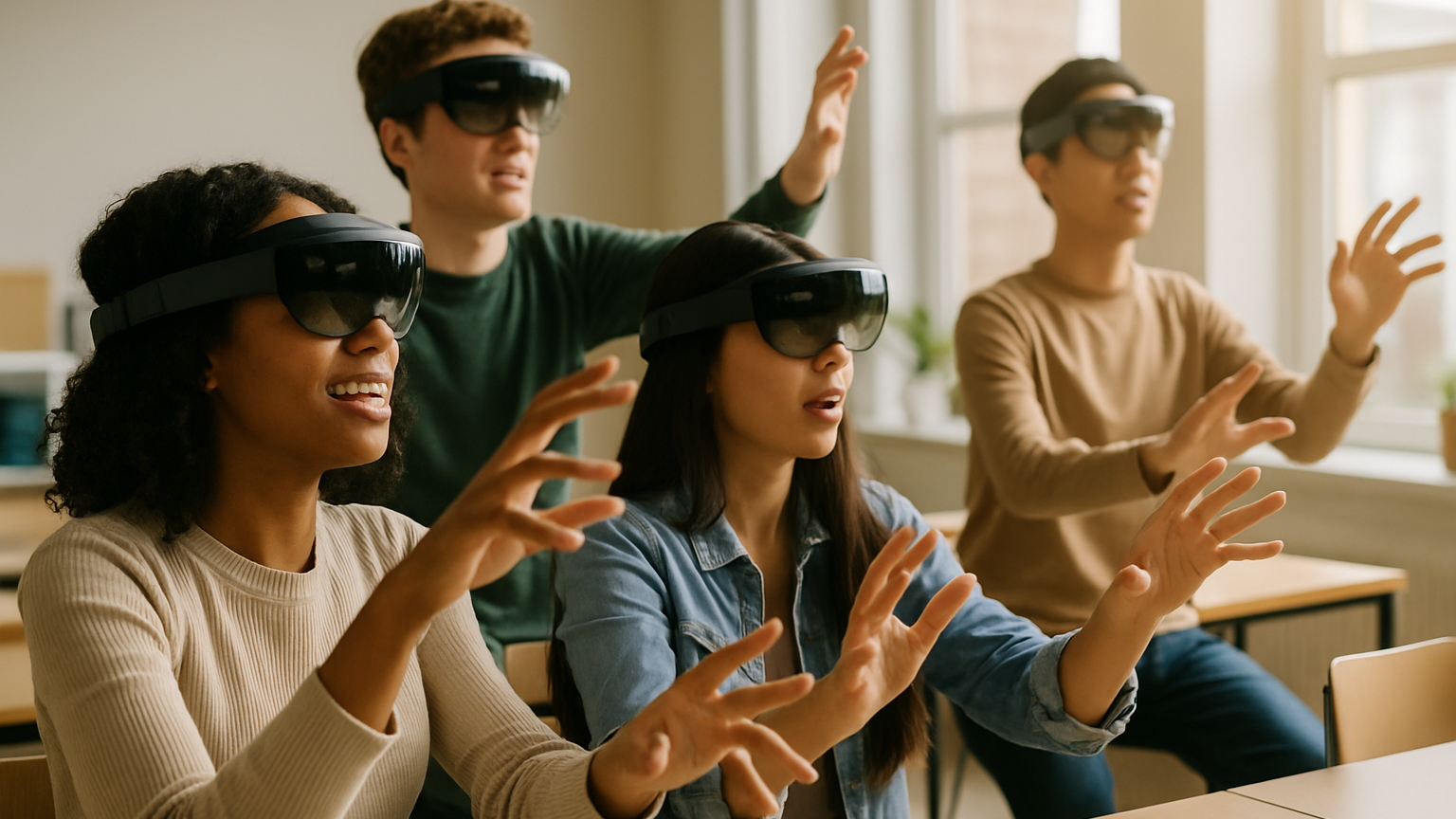
Picture a physics class where you don’t just talk about magnetic fields — you step inside one. Or nursing students who practice rare, high‑stakes procedures as many times as they need, without risk. That’s the practical promise of mixed reality training: moving students from reading about concepts to applying them with their eyes, ears, and hands. When learners are immersed, they remember more and transfer skills faster because the experience sticks. The result isn’t a shinier classroom; it’s better outcomes that show up in assessments, confidence, and readiness for the next level.
This approach fits K‑12, higher education, and vocational programs alike. Complex labs, fieldwork, and equipment training become accessible on demand, whether you’re on campus or in a satellite classroom. Students can practice, fail safely, and try again — a cycle that traditional labs or lectures struggle to scale. It’s also collaborative: teams can solve problems together in shared virtual spaces, which mimics how modern work actually happens. The short version: when students learn by doing in believable environments, theory turns into skill.
Why Mixed Reality Belongs In Modern Education
The strongest case for this technology is pedagogical, not technical. Mixed environments align with proven learning science: spaced practice, immediate feedback, and embodied cognition. RTE Global’s VRskills solution is grounded in cognitive science and human behavior, combining a VR software platform with content production and hardware management so the experience is both rigorous and repeatable. When you connect those dots, you get training that’s engaging and accountable — not just entertaining.
Access matters too. Many schools can’t run advanced labs every week due to cost, risk, or timetabling. With virtual modules, you can rehearse critical procedures safely and as often as needed — there’s no physical instructor required once the module is active, and it can run anywhere, countless times. That removes bottlenecks and makes high‑quality practice available to every student, not just the lucky few who get lab time.
There’s a reality check worth stating. If you’re hunting for a one‑day novelty or hoping to replace teachers, this isn’t your tool. It shines when you care about measurable learning, curriculum alignment, and consistent practice over a semester or year. Let’s be blunt: fancy headsets won’t fix a weak syllabus. But when they’re paired with strong objectives, the lift is real.
Beyond classrooms, museums and science centers use immersive learning to spark curiosity and anchor abstract ideas in lived experience. A well‑designed immersive VR attraction can turn a static exhibit into a mission students remember a year later. That same design logic — clear goals, believable worlds, safe repetition — transfers back into formal education beautifully. The thread running through all of it is presence: students feel like they’re there, doing the thing.
How It Transforms Learning: Immersion, Embodiment, Collaboration
Three levers drive the learning gains: immersion, embodiment, and shared space. Each works on a different part of the brain’s “this is real” signal. Together, they nudge learners from passive consumption to active problem‑solving. Here’s how they play out in practice.
Immersion: Make Concepts Tangible And Memorable
Immersion is about believable worlds: rich visuals, spatial audio, realistic physics, and responsive environments that react as students expect. When a simulation behaves like the real thing, attention locks in and distractions drop. Abstract ideas — like orbital mechanics or molecular interactions — become places you can visit, objects you can manipulate, and systems you can watch unfold. The brain treats those experiences more like memories than notes, which makes recall stronger when exams or real‑world tasks appear.
Embodiment: Learn By Doing With Natural Body Tracking
Embodiment maps a learner’s real movements to a virtual body with one‑to‑one precision. You don’t press a button to “pick up” a tool — you actually reach, grasp, and use it. That closes the gap between knowing and doing, which is exactly where many students struggle. With avatar alignment and natural gestures, practice looks and feels like the task itself, so skills transfer more smoothly back to the lab, ward, or workshop.
Shared Space: Real-Time Teamwork In Virtual Classrooms
Shared spaces let students and instructors communicate naturally inside the simulation. They can brief as a group, split roles, and solve problems together under time pressure, then debrief on what worked. That social layer builds soft skills — communication, leadership, situational awareness — while reinforcing domain knowledge. It also mirrors how modern labs, clinics, and factories actually operate: rarely alone, often together.
Mixed Reality Training In The Curriculum: Where To Start
Start with outcomes, not gadgets. Identify the 2–3 skills students consistently find hard to master — usually complex procedures, safety‑critical moments, or concepts that are hard to visualize. Map those to scenarios you can practice repeatedly, and define exactly what “good” looks like (checklists, rubrics, or clear behavioral markers). In practice, most teams start with one classroom pilot, gather evidence, and scale from there. That keeps risk down while building internal champions who can mentor colleagues.
- Choose a use case where real‑world practice is scarce, risky, or expensive
- Set measurable success criteria (time, accuracy, error types, reflection quality)
- Co‑design scenarios with subject‑matter experts and instructors
- Prepare facilitators: when to intervene, when to let the simulation teach
- Plan rollout logistics: room setup, headset rotation, cleaning, and student flow
Content matters as much as the tech. If you need help turning a syllabus into effective virtual scenarios — from concepting and user journeys to 3D assets — explore our AR and VR services. The best modules are tightly scoped: one clear objective, a believable environment, and immediate, specific feedback. That’s what turns novelty into durable learning.
Finally, decide how you’ll assess learning and reflect on performance. Capture attempts, errors, and decision points, then pair them with short debriefs that connect back to theory. Build those checkpoints into your LMS or course cadence so practice and evaluation reinforce each other. Mixed reality training works best when it lives inside the course, not next to it.
The Tech Stack: VR Platform, VRskills, And Hardware Management
Under the hood, you want a stack that’s as thoughtful as your pedagogy. RTE Global’s VR Platform delivers the training experience, while the VRskills solution wraps it with content production and hardware management. It blends advanced learning theory, data science, and 3D modeling so scenarios teach the right thing, not just anything. Standardized interfaces and pedagogical components — developed with leading research institutes — keep modules consistent and scalable.
Hardware should serve the lesson, not distract from it. Centralized device setup, updates, and rotation policies reduce friction and keep classes running. Because modules don’t require a physically present instructor to operate, you can run sessions across multiple rooms or campuses at the same time. That’s how you get true reach without burning out your staff.
If you’re mapping this to your program, explore RTE Global’s VR training solutions for examples of how immersion, embodiment, and shared space come together. You can start with existing modules and evolve toward custom builds as your curriculum matures. Either way, the platform gives you a stable base to grow from.
Proving Impact: Less Downtime, Safer Practice, Faster Skill Gain
Impact shows up in three places your dean or department chair cares about. First, time: learners reach competence faster when they can practice more often with targeted feedback. Second, safety: risky procedures become safe to rehearse, which reduces injuries and near‑misses during real labs or clinical placements. Third, operations: fewer bottlenecks and less downtime because sessions can run anywhere, on repeat.
Translate that into metrics you can track. For example: time‑on‑task to complete a procedure, the types and frequency of errors made, and how performance improves over attempts. Pair those with knowledge checks that test conceptual understanding, so you see both skill and reasoning grow. When students can demonstrate readiness in VR, instructors can allocate precious lab time to advanced work instead of basics.
Critically, the platform approach makes measurement practical. Because the same scenario runs the same way for every learner, you’re comparing apples to apples across sections and semesters. That repeatability is hard to achieve in physical labs where equipment, space, and human variables shift constantly.
If you aren’t ready to measure, or you can’t commit staff time to review session data and debriefs, it’s better to wait. The technology will still wow students, but the gains come from closing the loop between practice and feedback. No fluff, just practice.
From Enterprise To Education: What We Learned With Eurocash And Pepsi
RTE Global’s solutions have been tested and verified with leading industry companies such as Eurocash and Pepsi. Why should educators care? Because the constraints in enterprise training — safety, standardization, and scale — mirror what schools and universities wrestle with. When a module can certify thousands of staff reliably, you know the underlying design is robust enough for large cohorts of students.
The biggest transferable lessons are repeatability and autonomy. Once training is active, it can run anywhere and as many times as needed, without a physically present instructor. That frees your best educators to focus on coaching and higher‑order feedback while the platform handles consistent practice. It also simplifies scheduling across campuses and partner sites.
Bring that into your curriculum by starting with a small, clear goal and scaling intentionally. Pick one course, define success, and instrument it. In practice, most teams start with a pilot group of motivated instructors, iterate for a term, and then expand to adjacent courses. Mixed reality training grows best when you build community around it, not just inventory.
If you’re planning a broader rollout — integrations, governance, and content roadmap — align stakeholders early and document how decisions get made. A transparent playbook keeps momentum when the semester gets busy. For a view into how we organize delivery from concept to deployment, take a look at our software development process. The goal is simple: reliable, scalable learning that earns its place in your syllabus.