

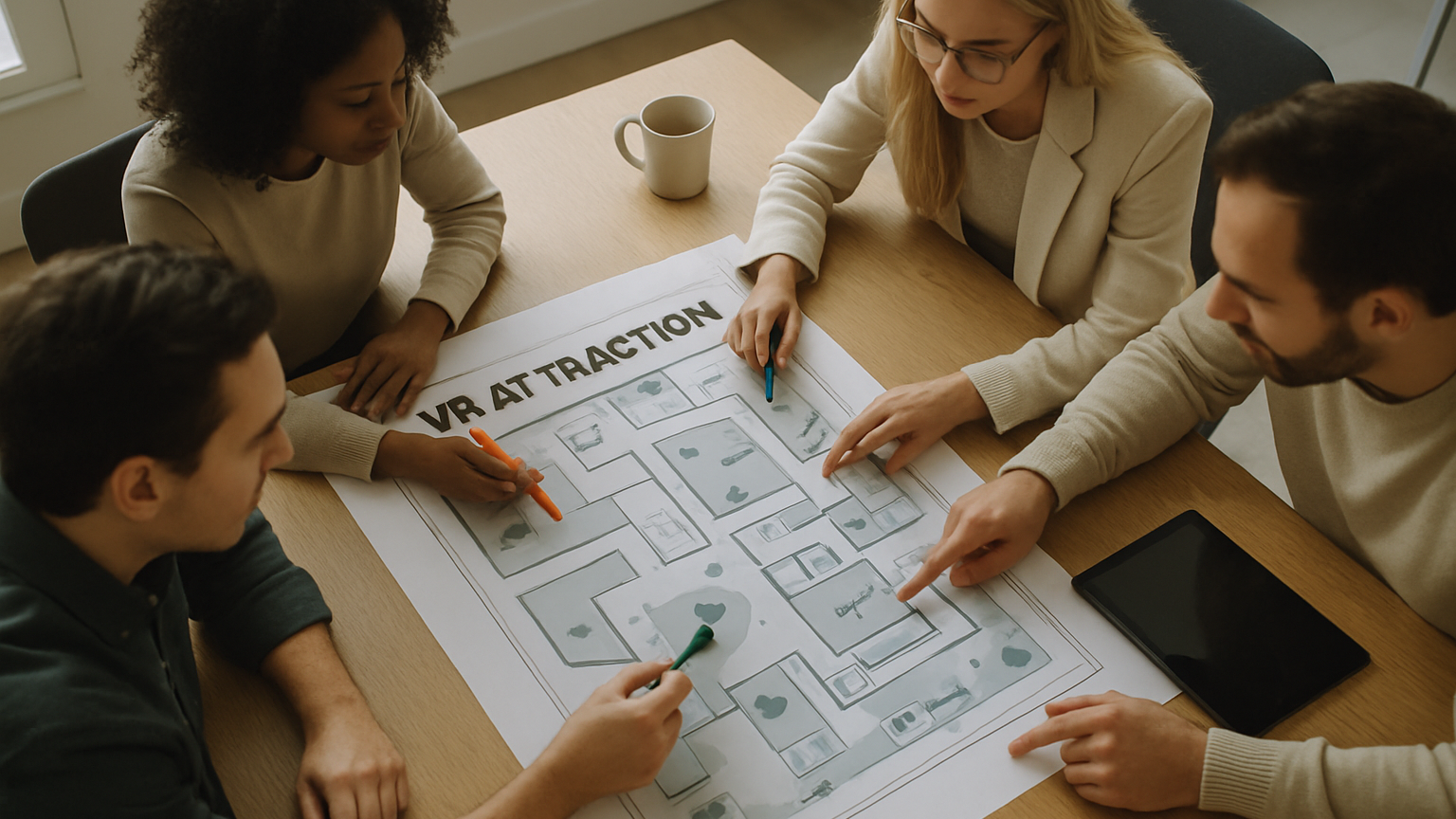
When you run a location-based VR experience, sales don’t just come from great content — they come from how many guests you can delight per hour without breaking the magic. That’s where VR attraction capacity planning quietly becomes your strongest commercial lever. Every minute you shave off loading, every extra seat you synchronize, and every smooth handoff between zones compounds into real revenue. Think of throughput as the number of paid, high-quality experiences you can consistently deliver when it matters most. Do this right, and marketing spend converts better, queues shrink, and per-cap rises because guests have time and energy to say yes to the add-ons.
Look at capacity through a sales lens and three levers stand out: throughput, utilization, and yield per guest. Throughput sets the ceiling; utilization fills it; yield turns each visit into more revenue through bundles, timed upsells, and moments worth paying for. In practice, most venues see lines surge on Saturday afternoons and fall to half by late Sunday morning — design for those peaks, and the rest of the week becomes easier. You don’t need a spreadsheet to feel this, but it helps. Let’s break down how to engineer capacity that sells.
Why Capacity Drives Sales In Location-Based VR
Capacity is the bridge between demand and revenue. If you cap out at 120 guests per hour and your peak demand wants 180, you’re not just leaving tickets on the table — you’re also creating friction that suppresses spending on everything else. Long lines drain energy, families split up, and impulse buys vanish because attention shifts from discovery to waiting. The flip side is powerful: a well-orchestrated flow keeps parties together, frees headspace for decisions, and makes every upsell feel like part of the show, not a tollbooth.
Capacity also affects perceived value. When guests move smoothly from check-in to briefing to the VR moment, they sense craft and care — and that makes premium pricing feel justified. Small adjustments compound: synchronized multi-user starts, clear pre-briefs, and staged gear prep can add 10–20% more starts per hour without feeling rushed. That extra headroom changes how you market, how you schedule groups, and how confidently you say yes to school bookings or brand activations.
There’s an honesty check here too. If your experience is intentionally boutique, highly contemplative, or built on scarcity as part of the art, aggressive capacity optimization is the wrong game. You’ll protect the vibe and charge accordingly. For most location-based VR aimed at families, school groups, and public attractions, though, sales growth tracks directly with the way you plan and run capacity. That’s the practical reality operators live with every weekend.
Forecast Demand And Align Throughput Across Weekparts
Start with a simple forecast by weekpart: school mornings, weekday afternoons, Friday evenings, Saturday prime, and Sunday taper. Use last month’s hourly admissions, local events, and weather patterns to set a baseline, then update it weekly. The goal is not a perfect prediction; it’s knowing when you’ll be at 60%, 80%, or 100% so you can match throughput to demand. This is the heart of VR attraction capacity planning because it tells you exactly where an extra synchronized seat row or a tighter turnover unlocks real sales.
Align throughput in two directions: vertical and horizontal. Vertical alignment adjusts cycle time and seat utilization for a given installation — think faster briefings, parallel gear-up, and clearer wayfinding. Horizontal alignment adds parallelism — more seats, a second bay, or staggered starts — so larger groups flow without fragmentation. If weekday mornings bring buses of students, schedule blocks with reserved slots and scripted group handling; if Friday nights skew to couples, shift to rapid-turn cycles that keep lines moving and date-night energy high.
Refine in 15–30 minute increments. You’ll spot micro-peaks before and after on-site shows, lunch windows for school groups, and post-work bursts around 18:00–19:00. Build cushions before those surges by pre-briefing and staging headsets in advance, then maintain tempo until the crest passes. After some time, one issue usually comes up: your average handle time drifts during peaks. Treat that drift as a signal to reassign roles or open an overflow queue, not as a reason to dilute the experience.
Design The Guest Journey To Reduce Queues And Lift Spend
Great capacity feels invisible because the guest journey does the heavy lifting. Split the experience into zones with purpose: arrival and ticket check, briefing, gear-up, the VR moment, and a shareable finale. Each zone should prepare the next so the VR bay is always the star, never idle. Large-screen previews in the queue keep energy high and explain what comes next; a clear, cinematic briefing reduces questions; gear-up stations set to the right heights and disinfected in advance make fitting fast and friendly.
Build a memorable ending that also unlocks revenue without feeling salesy. AI-powered photo generation in space suits or themed environments turns a fleeting moment into a keepsake guests want to share — and buy. That shareable beat is perfect right after the headset comes off, when emotions peak. Multi-user synchronization makes it even better because friends can react together, then capture that moment while the feeling is fresh. No fluff, just flow.
If you want a concrete example of a cohesive, multi-zone flow, look at our VR attraction Mission Orbit. It combines cinematic storytelling, synchronized multi-user VR, optional motion-based immersion, large-screen preview, and AI photo generation into one connected journey that is short, intense, and highly shareable. That modularity matters because you can adapt the zone mix to space, audience, and operational needs. When you design like this, capacity rises naturally and retail moments feel like part of the story, not a detour. If you need help shaping modules or adding AR touchpoints, explore our AR and VR services to see what’s possible.
Staffing, Safety And Sanitization Without Slowing The Line
People move capacity. Define roles that map to your zones: a greeter who verifies tickets and groups parties, a briefer who runs the script and checks fit, a dispatcher who manages start cadence, and a hygiene lead who turns headsets fast and safely. Cross-train so each role can cover one adjacent task during spikes. Simple visual cues — colored lanes, headset racks labeled by size, timers visible to staff — keep cadence predictable. Safety checks belong to muscle memory, not memory alone, so script them into the dispatch rhythm.
Sanitization can be both rigorous and rapid. Stage disinfected headsets on a clean rack while used units move to a clearly marked return bay; run a consistent wipe and inspection pattern that takes seconds but never varies. If your installation uses motion platforms, include a quick restraint check and a stop-clear-go protocol so dispatch never compromises safety. The trick is to make hygiene part of the choreography rather than an afterthought that eats cycle time. That way, cleanliness signals quality instead of delay.
Training closes the loop. Short, scenario-based refreshers before weekends keep standards high and drift low, and digital checklists help new hires ramp quickly. If you’re scaling teams across multiple locations, standardized onboarding with immersive modules pays back quickly; this is where our VR training technology can support consistent, high-quality operations. When teams move in sync, you protect guest comfort and keep throughput exactly where sales need it.
Pricing, Session Length And Seat Count: Find Your Sweet Spot
Pricing and throughput are joined at the hip. Shorter sessions increase starts per hour and create more chances to sell photos and merch; longer sessions justify higher price points but can cap total yield if you regularly hit demand peaks. The right answer depends on your audience mix and what they value: intensity and shareability, or depth and exploration. Test small changes first — a one-minute trim to briefing, or a minor adjustment to seat count — and watch both conversion and per-cap spend. The sweet spot emerges where you sell out your peaks without depressing weekday volume.
Here’s a simple way to compare session strategies without getting lost in jargon. Treat each option as a bundle of guest value, throughput, and upsell potential. Bring your team to the floor, watch real cycles, and measure true handle time including clean and reset. Numbers on paper are tidy; the lived cadence at 3 pm on Saturday is the truth. Align price with the experience guests actually feel there.
- Shorter sessions: higher starts/hour, strong shareability, more photo/merch opportunities, but less narrative depth.
- Longer sessions: richer storytelling and motion moments, higher ticket price potential, but fewer seats/hour and tighter peak capacity.
As you tune seat count and cycle time, keep group behavior in mind. Families and school groups want to experience together, so synchronized multi-user starts help both satisfaction and sales. Couples and friends tolerate staggered starts if the pre-show is engaging and clear. If you plan a change that touches layout or dispatch logic, map it end to end with timing marks; that’s where a transparent, iterate-and-measure approach like our software development process mindset pays off operationally too.
VR attraction capacity planning for a multi-user experience like Mission Orbit
Key Inputs: Seats, Session Duration, Turnover, Attendance
For multi-user VR with synchronized playback, four inputs drive capacity: available seats, session duration, turnover time, and expected attendance by weekpart. Mission Orbit, for example, was designed as a modular, scalable attraction that can synchronize content across multiple seats and even include motion-based immersion. That modularity lets you tailor seat count and zone layout to your real demand profile. Pair those inputs with your booking mix — walk-up versus groups — and you’ll see exactly which lever unlocks the most revenue. This is VR attraction capacity planning translated into practical knobs you can turn.
Throughput Formulas And Scheduling Scenarios
Use a simple structure to estimate starts per hour: Throughput = Seats × (60 ÷ Cycle Time), where Cycle Time includes the VR runtime plus brief load/unload and hygiene steps. Then adjust by your realistic occupancy rate for that weekpart. For illustration, if you ran 8 synchronized seats with a 10-minute cycle, you’d target roughly 48 starts/hour at full occupancy; trim a minute of turnover and you add nearly 6 more starts without changing content. The lesson is clear: shaving small, repeatable seconds beats chasing big, rare wins.
Scheduling ties the math to the floor. Stagger pre-briefs so a new cohort is always ready as the previous one exits, and keep a small buffer to absorb headset adjustments or motion platform checks. For groups, pre-assign seats and color-code lanes to reduce last-second reshuffles, then trigger synchronized starts on a predictable cadence. If your demand comes in waves, alternate between rapid-turn cycles and slightly longer cycles with bonus moments — a cinematic preview or an extra educational beat — to maintain rhythm without wasting capacity.
Revenue Uplifts From Add-Ons Like AI Photos And Merch
Multi-user VR creates a shared emotional spike that is perfect for add-ons. Mission Orbit can generate personalized AI photos in space suits or cosmic environments — an easy, high-conversion keepsake right at the exit. Place the capture point inside the natural flow and time the offer for when groups reunite and react together. Light-touch merchandise near the finale — patches, mission badges, or themed notebooks — rides the same wave. These aren’t bolt-ons; when integrated into the journey, they lift yield without adding friction to dispatch.
One caveat: if your footprint is extremely tight or your weekday volume is low, building heavy multi-user seating just for peak hours may not pay back. In that case, prioritize a compact, modular layout with fast turnover and a strong photo moment that scales softly. If demand grows, you can add seats or a second bay later. That’s the advantage of a modular, immersive setup designed for scalability — you can grow capacity in lockstep with sales rather than betting the farm on day one.