

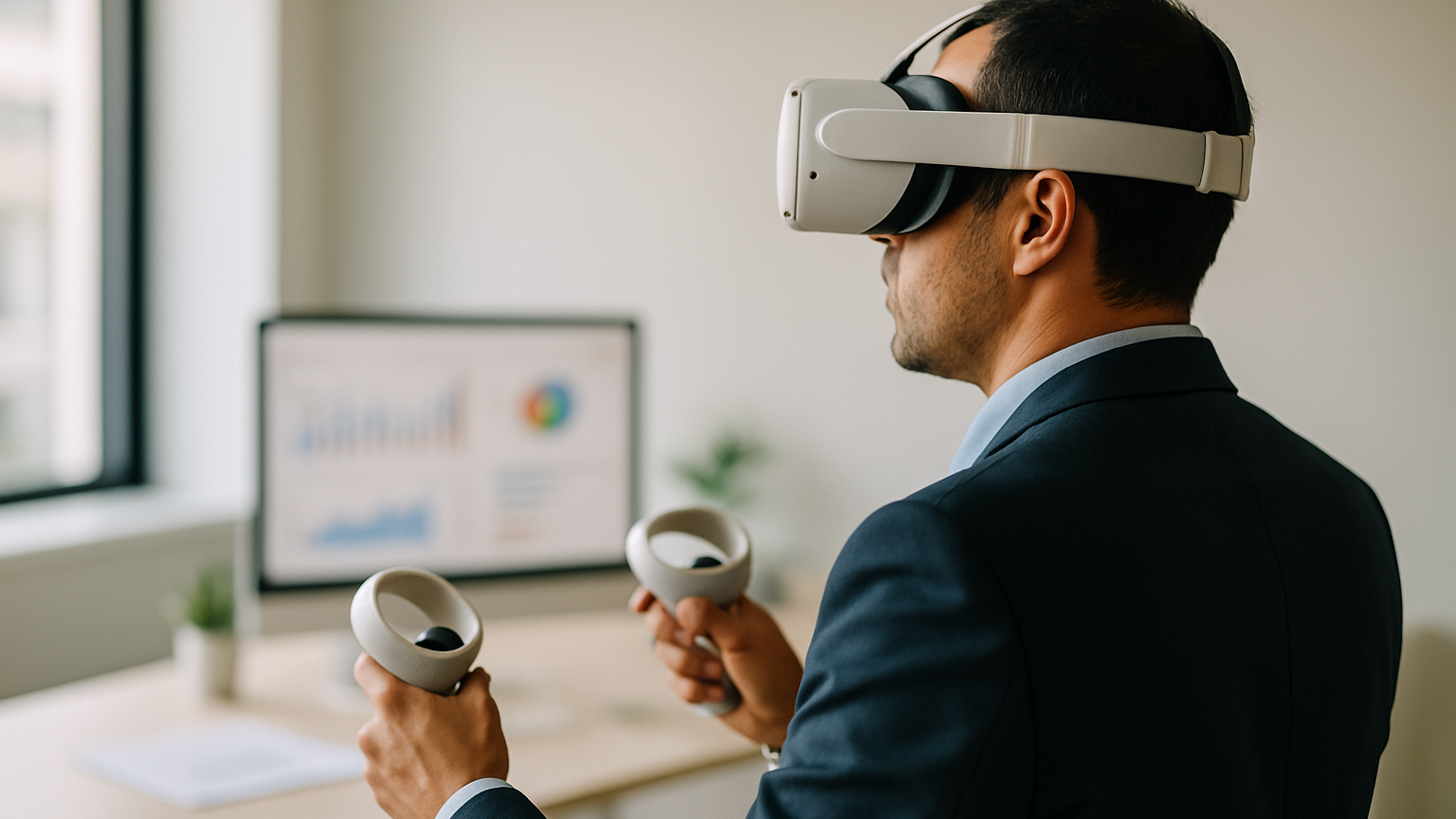
Your CFO doesn’t buy headsets. They buy payback. A VR training platform only wins when it cuts accidents, trims travel and instructor hours, and puts people on the job faster with fewer mistakes. That’s the bar. RTE Global’s VR training technology has been tested with companies like Eurocash and Pepsi, and it’s built for exactly this: reduced downtime and fewer injuries, plus the ability to train without a live instructor. In plain terms, you standardize skills at scale and stop paying for the same class again and again. No fluff, just numbers.
In this guide, we make the business case, map the stakeholders, and show how to pilot, scale, and forecast payback with confidence. We’ll also outline how we de-risk delivery—from discovery and prototyping to QA, deployment and support—so you’re never gambling budget on an unproven idea. You’ll see where integration with your LMS and SOPs either unlocks value or quietly kills it. And yes, you’ll get board-ready proof points: 140+ completed projects across multiple regions and recognizable brands that expect measurable outcomes. If you’re evaluating a VR training platform to drive sales-worthy ROI, you’re in the right place.
The Business Case: Costs Down, Safety Up, Skills Retained
Start with cost. Traditional training leans on travel, instructor availability, and taking key people off the floor for half a day or more. A VR session compresses the schedule, removes dependence on a single expert, and repeats consistently across sites. When your curriculum runs in-headset, you can train after a shift change, during a lull, or in a dedicated room without flying anyone in. That directly reduces downtime and slashes the soft costs that never show up on a line item—but always hit your margins.
Then safety. VR lets you simulate hazardous, high-variability tasks without exposing people or equipment to risk. You can rehearse lockout/tagout, spill response, or confined-space checks as many times as needed until behaviors are habit. The outcome is fewer incidents and near-misses because operators have already “lived” the scenario before it happens. That aligns with what we deliver: reduced injuries and smoother operations, which cascade into lower insurance exposure and steadier production.
Finally, retention. People don’t absorb procedures the same way from a slide deck as they do with a controller in hand. In VR, learners practice decisions, not just recall bullet points, and they get immediate, objective feedback. Picture a new warehouse hire learning forklift maneuvering: three short VR runs that focus on blind corners, pallet height, and aisle etiquette will beat a single long lecture every time. The result is skills that stick and fewer rookie errors that quietly eat your P&L.
A quick reality check: this approach isn’t for every situation. If you only train a few dozen people a year, your processes change monthly, or the work is so simple that errors are cheap, a headset rollout may not pencil out today. Digital content also demands ownership—if there’s no one to keep SOPs current, the value decays. That honesty up front saves you from a pet project that stalls after the demo glow fades.
Who Buys And Why: Speak To CFO, Operations And L&D
CFOs sign when they see predictable cash impact. Frame the investment as either capex amortized over the content life or opex tied to usage, then model cost-per-competent-employee versus the status quo. Show the line items you reduce—travel, classroom time, scrap from early errors, incident costs—and the working capital you protect by shortening ramp-up. Spell out the payback window scenarios and the KPIs you’ll track weekly. Make it boringly clear how the VR training platform converts into EBITDA.
Operations cares about throughput, uptime, and consistency across shifts and sites. They need the same procedure run the same way, every time, without waiting for the one expert trainer who’s booked solid. VR training technology delivers standardized practice and objective assessment, so a plant manager can trust a new operator on Line 3 at 6 a.m. as much as on Line 1 at noon. The moment ops sees fewer stoppages during onboarding, the conversation moves from „interesting” to „essential.”
L&D needs engagement, measurement, and governance. They want scenarios that branch based on choices, assessment that goes beyond a multiple-choice quiz, and content they can update when a SOP changes. With VR, you track behaviors—sequence, timing, compliance—then map them to competencies instead of just attendance. Pair that with training without a live instructor and you unlock capacity for L&D to focus on strategy, not scheduling.
Tie this together into a single pitch: for Finance, it’s payback backed by numbers; for Operations, fewer stoppages and a steadier ramp; for L&D, consistent, measurable skill building. RTE Global supports all three with a VR platform and solutions like our VRskills approach, built to scale across sites, languages, and changing procedures. When each stakeholder hears their metric spoken back to them, the budget conversation gets simple. That’s how you turn interest into a funded project.
VR training platform ROI: Pilot, Scale And Payback Windows
Start with a hypothesis and a baseline. Which KPI will move: time-to-competency, first-time-right, incident rate, or unplanned downtime? Collect pre-pilot numbers for a fair comparison, then define pass/fail thresholds you’d be comfortable presenting to the board. Keep the scope tight, but representative of real work, and ensure you can measure results weekly. If it can’t be measured, it can’t be sold internally.
Design the pilot around reality, not a showcase. Use an everyday scenario that causes genuine friction—like changeovers, forklift traffic patterns, or order-picking accuracy—then run a small cohort across at least two shifts. Mix in new hires and transfers to observe variance and capture feedback. Capture time-in-training, errors in-sim, and on-the-floor performance after training. Close the loop with managers so you correlate headset performance with real productivity.
Scaling means standardizing content and logistics. Break content into modules tied to SOP sections so updates are surgical, not a rewrite. Align hardware with shift patterns and room availability so training becomes a routine, not a calendar fight. Decide how you’ll schedule sessions—self-serve, supervisor assigned, or LMS-triggered—and codify who approves content updates. The smoother the runbook, the faster you bank the savings.
When you forecast payback, use ranges and make the math transparent. Show low/likely/high outcomes for reduced downtime, avoided incidents, travel savings, and faster ramp. Include content maintenance and device management so the model isn’t rosy by omission. Manufacturing scenarios with high incident costs tend to pay back faster than low-risk office workflows; onboarding in retail can pay back within a peak season if churn is high. The point is a clear, auditable model your CFO can interrogate and still nod yes.
From Pilot To Scale With RTE Global: How We De-Risk Delivery
You want a partner who treats outcomes—not just outputs—as the deliverable. RTE Global has completed 140 projects and operates across multiple regions, combining emerging technology with strategic and creative thinking. Our process is built to remove uncertainty at each stage so you can move from idea to adoption without drama. Here’s how that plays out on a typical engagement.
Discovery And ROI Targets Aligned To Your KPIs
We begin with documentation of your business needs and current KPIs—time-to-competency, incident categories, throughput, or quality escapes. Together, we define ROI targets the board will recognize and convert them into acceptance criteria. That alignment avoids scope creep and ensures every scene, asset, and assessment exists to move a number you care about. It’s the difference between a cool demo and a rollout that funds itself.
Prototyping, Content Design And User Testing
Our UI/UX team builds interactive prototypes based on your requirements, then iterates with your SMEs so procedures and edge cases are nailed down early. We design immersive environments and interactions that mirror your floor, tools, and signage, so transfer to the job is natural. User testing with a representative group validates usability, clarity, and assessment before any large-scale production. Development runs in sprints, keeping feedback loops tight and risks visible.
Deployment, QA And Ongoing Support
Before rollout, our QA team tests the code and scenarios thoroughly, then we stage deployment with your IT and site leads. We monitor system performance and learner analytics after go-live to spot issues, optimize difficulty curves, and guide content updates. Maintenance and support keep content aligned to your SOP changes and device fleets healthy. In practice, most teams see smoother sessions by week two as supervisors fold VR into their regular onboarding rhythm.
Integration And Content: Make It Work With Your LMS And SOPs
Integration is where ROI is won or lost. Your LMS already orchestrates enrollments, reminders, and completions, so the VR experience must slot into that flow cleanly. We align scenarios to your competency framework and reporting cadence so managers see progress in the same dashboards they already trust. Single-source-of-truth for learner records means fewer spreadsheets and fewer surprises. Keep it simple for frontline teams and the adoption curve flattens fast.
Content governance matters as much as creative. We tie each module to a specific SOP section and version, so when procedures change the update is targeted and tracked. Modular design also supports multi-language builds without redoing everything from scratch. That’s how you maintain accuracy at scale without ballooning costs.
On the IT side, plan for device management, network constraints, and update windows that won’t collide with peak operations. Decide early how you’ll provision headsets, handle authentication, and push content across sites. Clear runbooks prevent last‑minute scrambles that sour stakeholders. Get these basics right and you remove the invisible friction that kills momentum.
Finally, measurement. Tie in analytics that reflect what leaders care about—completion is not competence. We capture in-sim behaviors aligned to competencies and feed outcomes into your reporting stack, supported by our background in custom software and inbuilt analytics integration. When a line leader can open their usual dashboard and see fewer errors after VR sessions, the case sells itself. That’s the loop from headset to P&L.
Proof Points You Can Take To The Board: Pepsi, Eurocash, 140+ Projects
RTE Global’s VR training technology has been tested with leading companies such as Pepsi and Eurocash. The value shows up in fewer incidents and reduced downtime, plus the flexibility to train without an on-site instructor. Those aren’t novelty outcomes; they’re operational drivers your board recognizes. It’s the difference between „we trained people” and „our ramp-up got faster and safer.”
Across 140+ completed projects in multiple regions, we’ve learned that scale wins come from boring reliability as much as clever content. Governance, QA, and integration protect your investment long after launch. In real life, most teams start with one site, then roll to two or three once the early numbers hit their marks. That’s when the investment narrative shifts from cost to capability.
If you want to see execution depth beyond training, look at our brand work like the Coca Cola proximity marketing project. Different domain, same discipline: clear goals, thoughtful design, reliable delivery. It demonstrates our ability to partner with household names and ship under pressure. That steadiness is exactly what you want when your reputation is on the line.
Bring this to your next board review: a transparent ROI model, a pilot-to-scale plan, and stakeholder messages that answer Finance, Operations, and L&D in their own language. A VR training platform should not be a leap of faith—it should be a calculated move with credible proof. When it reduces downtime and injuries while standardizing skills, it pays for itself and then some. Sounds blunt? It is.