

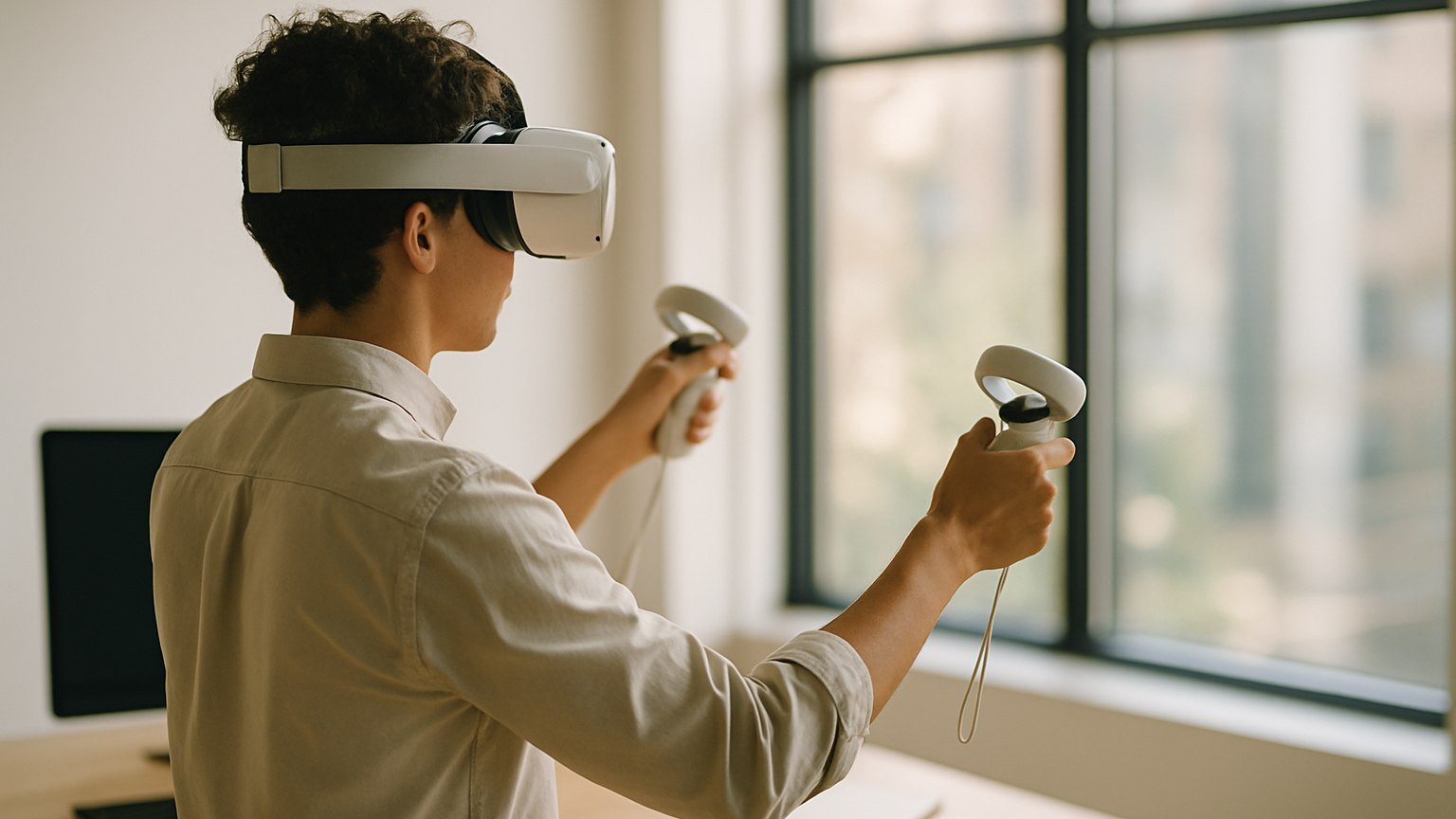
Let’s be blunt: traditional training often eats budget without moving the needle on real‑world performance. Travel, classroom time, downtime on the line — it adds up fast. And even after all that, behavior on the job can still be inconsistent. A VR training platform changes that equation by shifting training from “telling” to “doing” at scale. People don’t just read procedures — they perform them in a lifelike environment and get immediate feedback. The result is practical skill, not just checked boxes.
CFOs care about cost curves and risk. COOs care about uptime and quality. L&D leaders want engagement and measurable learning. VR training brings these threads together: our solution combines virtual reality with proven learning theory, data science and 3D modeling so staff practice tasks, make decisions and learn from consequences — safely. It reduces downtime, injuries and time spent in training by enabling practice and certification entirely in VR, with no instructor physically present. Once activated, training can run anywhere, as often as needed — see our VR training technology for the approach we use.
Who isn’t this for? If your goal is a one‑off compliance lecture or a slick demo for a trade show — skip VR. This approach shines when you need hands‑on skills, consistent behavior and repeatable quality across sites. It also requires commitment to content and change management; a headset alone won’t fix a broken process. No fluff, just measurable behavior change.
Why organizations buy a VR training platform
The first trigger is risk. Where a mistake can injure someone, contaminate a batch, or halt production, simulated practice is the safest path to mastery. In VR, employees rehearse critical steps under pressure, make controlled errors and see consequences — without touching a real machine or product. That builds judgment, not just memory. And because scenarios run on demand, exposure isn’t limited by instructor calendars or facility access.
The second trigger is scale. When you need consistent training across multiple locations, classrooms can only go so far. A platform lets you deploy the same content everywhere, update it centrally and track progress in a unified way. Our VRskills approach includes a software platform, content production and hardware management so you don’t end up stitching together a dozen tools. Together with leading research institutes, we’ve developed standardized interfaces and pedagogical components that keep learning outcomes predictable.
The third trigger is engagement that sticks. Immersive environments with lifelike AI, physics, lighting and haptics create a credible sense of presence. When learners feel they’re really there, attention spikes and retention follows. In practice, most teams report that people come out of sessions talking about what they did, not what they were told — a subtle shift that signals deeper learning.
Capabilities that move the needle: immersion, collaboration, control
Real impact comes from three capability groups that work together. First, high‑fidelity immersion and embodiment so the environment feels real and the learner’s virtual body matches their own movements. Second, shared space for natural communication and multi‑person scenarios. Third, the operational backbone — content, data and hardware management — that lets you run training anywhere, at any time, without babysitting every session.
Immersion, embodiment and presence that boost retention
Immersion is the perception that a digital environment truly exists. When VR surrounds the senses with convincing visuals, spatial audio, realistic physics and responsive systems, the brain stops treating it as a “demo” and starts treating it as a place. Learners execute procedures, diagnose issues and solve real problems rather than passively consuming content. That’s why hands‑on skills build faster and stick longer.
Embodiment takes it further by aligning an avatar with the learner’s body using precise one‑to‑one tracking. You look down, see your hands, and they move exactly as you move. Subtle, but it matters — muscle memory only forms when action and feedback are tightly coupled. We’ve honed presence across many immersive builds; if you want a taste of our craft outside training, explore the Mission Orbit immersive experience — different use case, same commitment to believable worlds.
Content, data and hardware management for scale
VRskills combines a software platform with content production and hardware management so training doesn’t stall after a promising pilot. You can publish or update scenarios centrally, roll them out across sites, and keep devices compliant and ready. Because training runs without a physically present instructor, sessions aren’t limited by schedules — staff can practice and even get certified in VR. That’s how you multiply seat time without multiplying costs.
On the analytics side, our methodology draws on advanced learning theory and data science. That means scenarios designed for measurable decision points and performance check‑offs, not just wow‑factor moments. Working with leading research institutes, we’ve standardized interfaces and pedagogical components to keep content consistent and outcomes comparable across cohorts. Control isn’t about locking things down — it’s about making improvement repeatable.
Expected outcomes: fewer incidents, faster onboarding, consistent quality
Safety and reliability come first. Our training technology has been used to reduce downtime, injuries and the overall time spent in training by letting people practice the exact tasks they perform on the job — inside VR. They can face rare but critical situations, make decisions and learn from errors with no real‑world consequences. That experience transfers when it counts.
Onboarding accelerates because new hires don’t wait for machines to be available or senior staff to free up. They can run through core procedures again and again until performance is fluent. And because everyone trains on the same scenarios, quality isn’t left to chance — it’s built into the process. Think of it as standard operating procedures you can step into.
There’s a cost story too. Travel and instructor time shrink, classrooms aren’t a bottleneck, and production assets stay online. Engagement tends to rise because people are doing meaningful work inside the headset, not sitting through slides. And once content is live, it can run anywhere, as many times as needed, which compounds ROI over time.
How we deliver: from pilot to scale with 140+ projects behind us
We’ve completed more than 140 immersive projects, and the pattern for success is clear: start focused, scale deliberately. We begin by pinpointing one or two high‑value scenarios where mistakes are costly or learning access is limited. That pilot proves value and clarifies the blueprint for broader rollout. It’s not theory — it’s the fastest path to stakeholder buy‑in and operational fit.
From there, our team moves through strategy and creative development into production. That includes treatments, user journeys and pre‑visualizations, then art direction, 2D/3D design and realtime VFX with spatial audio. On the engineering side we build custom applications and immersive environments that create a strong sense of presence. The goal is a believable world aligned to your procedures and KPIs.
Deployment covers hardware selection, device fleet setup and content distribution so you can run sessions without scheduling an instructor. Updates and new modules roll out centrally; support keeps devices healthy and content current. If you want the broader picture of how we work, take a look at nasz proces rozwoju oprogramowania — it outlines the steps from discovery to release.
What to budget and how to compare vendors
Budget depends on scope, fidelity and scale — and it’s more nuanced than headset count. Content is typically the main driver: the number of scenarios, their complexity, the need for lifelike AI or physics, and how often procedures change. Operational factors matter as well: multi‑site deployment, device management, and the level of analytics and certification workflows you require. Finally, plan for change management so the rollout lands with managers and floor teams — that’s where ROI actually happens.
- Immersion quality and embodiment: do actions feel natural and responsive?
- Operational backbone: can you update content centrally and manage devices at scale?
- Measurement: are decision points and performance check‑offs built into scenarios?
- Instructor‑free delivery: can sessions run anywhere, anytime, without on‑site staff?
- Proof with industry peers: deployments verified with recognizable companies?
- Roadmap and support: who maintains content and hardware, and how often?
When you evaluate partners, look for teams that combine emerging tech with strategic and creative thinking — not just one or the other. It’s the difference between a cool demo and a durable program. Explore nasze usługi w zakresie AR i VR for a sense of breadth, and if your comparison includes broader integrations or custom apps beyond training, our experience with nasze rozwiązania w zakresie rozwoju oprogramowania can de‑risk that side of the build. The best choice isn’t the flashiest — it’s the one that keeps delivering quarter after quarter.
Real-world proof: deployments with Eurocash and Pepsi
Our solutions have been tested and verified with leading industry companies including Eurocash and Pepsi. Those programs focused on real operational needs — from safety and equipment handling to repeatable process execution. Teams practiced critical scenarios in VR, received immediate feedback and repeated until performance was consistent. That’s the kind of discipline you want when human factors drive outcomes.
Because sessions can run without a physically present instructor, sites trained more people without tying up senior staff. Content updates rolled out centrally so procedures stayed in sync across locations. And since training can run anywhere and as many times as needed, exposure rose while logistics dropped — a rare win‑win for operations and learning.
A small, honest detail from the field: after the second week, one recurring insight usually pops up — teams ask for more scenarios that mirror their edge cases. That’s when you know the program is landing, because learners pull for practice rather than being pushed into it. If you’re aiming for the same outcomes and want a VR training platform mapped to your workflows, we’re ready to help you pilot and scale it the right way.