

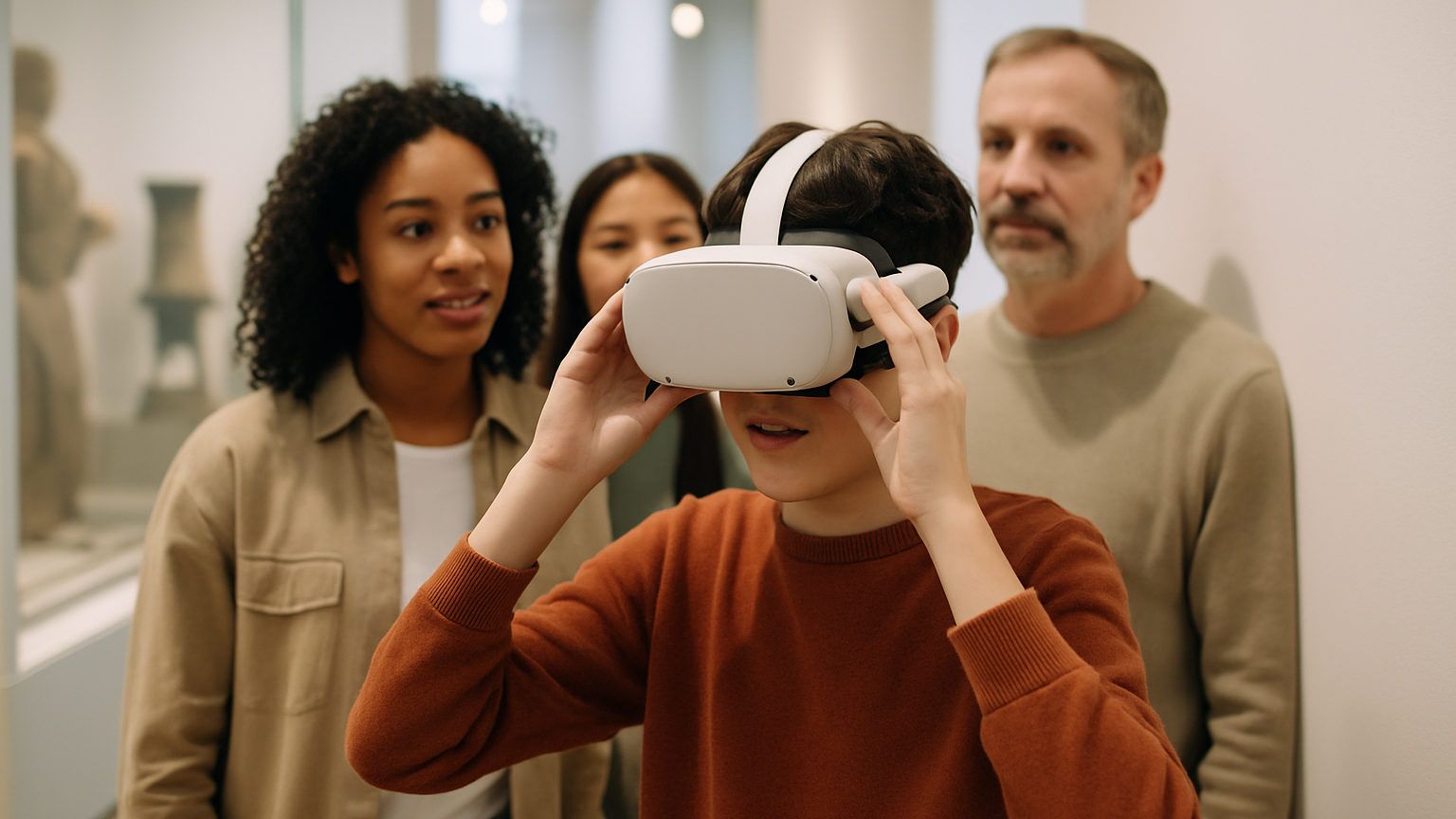
Visitors don’t buy tickets for technology. They buy for emotion, story and the promise of a moment they’ll remember. That’s why VR attractions for museums work when they deliver a clear “wow,” move people efficiently and give them something to share. If you’re aiming to grow attendance and per-cap spend this season, think beyond a headset demo and design the whole visit: pre-show, main event, photo, and post-experience touchpoints. The result is not just footfall, but a repeatable sales engine. And importantly, one that can flex for families, school groups and event audiences without retooling your floor every month.
Museums that win with immersive content do two things well: they make the spectacular operational, and the operational spectacular. Multi-user synchronized playback, motion that matches the story, and a built-in photo moment turn a 6–8 minute attraction into a social magnet. In practice, most families decide in under a minute if a queue feels worth it, so your pitch is what they see, hear and feel from the line. Keep the promise clear: short, intense, highly shareable. Then back it with smooth throughput and staff who can reset fast between cycles. That’s the difference between a novelty and a reliable revenue driver.
Why Museums Are Betting On Immersive Experiences To Grow Revenue
Immersive experiences pull visitors from spectator to participant. When a guest becomes part of a mission, a story or a challenge, they value the ticket more and talk about it more. That talk travels fast: a cinematic launch sequence or a tactile motion cue is the kind of clip that lands on group chats and social feeds. It’s also the kind of memory that nudges a family to come back with friends. That loop—experience, share, return—is the simplest growth flywheel a museum can build right now.
There’s also a practical reason: well-designed VR is compact. You can fit high-impact, multi-user content into a footprint that a traditional gallery might struggle to activate at the same intensity. Synchronizing several seats to the same story means families ride together, school groups move in batches and events flow without gaps. Add a large-screen preview and you entertain the queue while previewing the value of the upsell. That’s revenue thinking built into the floor plan.
Crucially, modern installations are modular. You can adapt the zone to your available space, audience profile and operational needs without compromising the core experience. For museums with seasonal programming, this flexibility matters: refresh content, swap optional modules, keep the attraction current without rebuilding from scratch. And because the experience is designed to be easy to operate and accessible for different age groups, you avoid the classic trap of buying a showpiece that only a fraction of visitors can enjoy.
Honest note: this approach is not for every institution. If your strategy demands entirely passive exhibits with zero staff interaction, or if headset sanitation and basic queuing are off the table, skip a headset-based attraction and consider screen-based or AR layers instead. The point is to match the medium to your operations, not to force-fit technology. No fluff, just results.
VR attractions for museums: What Sells, What Scales
What sells is story plus sensation. A cinematic rocket countdown that you feel in your seat. Crew roles that turn visitors into mission participants. Clear goals, clear stakes, a beginning and an end that land fast. When guests understand the arc in seconds and feel it in their body, they commit to the line—and they recommend it afterwards. The bonus: that same clarity makes training staff simpler and reduces friction at every step.
What also sells is the memento baked right into the experience. A photo moment—ideally AI-personalized into a space suit or dramatic scene—turns excitement into something tangible. Offer a one-tap digital share and a premium print, and you have an emotional upsell that doesn’t feel pushy. Families love it because it’s their face, their mission, their moment. Your retail loves it because it drives attachment to themed merchandise.
What scales is modularity and synchronized throughput. Multi-seat playback means one operator can run a batch with minimal downtime, while motion platforms—2DoF or 3DoF—deliver realism without intimidating first-time VR users. Optional modules—AR objects, touchscreen applications or browser-based content—expand capacity and create a no-headset path for guests who prefer to observe. The combination keeps lines moving and floors balanced on peak days.
Where this does not fit: venues with no tolerance for short pre-briefs, or policies that rule out any facial-worn device. In those cases, lean into large-screen previews and interactive touchscreens as the primary layer. You can still tell a mission story and sell the photo or retail moment, just without the headset core. The key is to preserve the arc and the emotional punch—the tech is the means, not the end.
Designing For Throughput And Accessibility Without Losing The Wow
Throughput starts with cycle time, not seat count. Map the guest journey—briefing, seating, headset fit, experience, photo, reset—and trim micro-delays at each step. Standardize gestures and language for staff so every reset is the same. Use visible clocks or soft cues in content to pace transitions naturally. The smoother the handoff between phases, the more guests you serve without anyone feeling rushed.
Synchronized multi-user playback is your friend. Families ride together, school groups move in pods, and your operator keeps control with a single start. A short pre-show clarifies safety and story beats before headsets go on, which reduces on-ride confusion and keeps energy high. Queue screens showing a preview of the mission entertain the line and prepare visitors for the posture and motions they’ll feel. It’s small things like that which shave minutes without cutting magic.
Accessibility is designed in from the first storyboard. Offer comfort-first seating with secure restraints, straightforward headset adjustment and clear opt-outs at every stage. Subtle motion cues (rather than aggressive tilts) broaden the eligible audience while keeping immersion high. Provide a non-headset viewing option—like a large-screen preview—so guests who sit out still feel included. And keep sanitation fast, visible and consistent to build trust with families and schools.
To keep the wow, balance spectacle with control. Cinematic audio, lighting sync and tactile feedback can deliver intensity without overloading comfort. Build to a clear climax—the liftoff, the docking, the flyover—and land with a satisfying, shareable photo moment. That last beat is not an afterthought; it’s what turns emotion into memory, and memory into merchandise. When you design for both feelings and flows, you sell more tickets without asking guests to compromise.
Revenue Models That Work: Tickets, Groups, Merch And Sponsors
A strong immersive zone earns in four ways: timed-entry tickets, group bookings, retail add-ons and external funding. The mix you choose depends on your calendar and audience split, but the mechanics stay similar. Make the core admission simple to understand, then layer optional value that guests actively want—photos, bundles, themed retail. For education-heavy venues, align learning outcomes with curriculum so schools can justify the trip. And keep sponsors in the loop with clear proof points they can share with stakeholders.
Pricing For Peak Days Versus Weekdays
Dynamic pricing can smooth demand and lift net revenue without confusing guests. On weekends and holidays, lean on timed-entry slots and family bundles that guarantee seats together. On weekdays, pair the attraction with general admission or exhibit access to encourage exploration and longer dwell time. For schools, pre-sell blocks with clear onboarding and a simple check-in to keep buses on schedule. Consistency in how you communicate these options matters more than squeezing every last cent out of each tier.
Upsells That Convert: Photos, Bundles And Retail
Photo offers convert when they’re personal and instant. AI-generated images of visitors in space suits or dramatic cosmic scenes give families a keepsake that feels uniquely theirs. Package a digital share with a premium print, and place themed merchandise—mission patches, notebooks, models—within easy reach at pickup. Consider a value bundle that includes photo plus a small retail item for a single tap. Keep the pitch friendly and visual; the image should do most of the selling.
Funding Paths: Sponsors, STEM Grants And Partnerships
Sponsors like stories they can stand behind. A space mission framed around teamwork, problem-solving and real-world science aligns naturally with technology brands and education-minded partners. Build a clear benefits outline: logo presence at the zone, co-branded content moments, and measurable reach through school programs. Explore STEM-focused grants that support hands-on learning and workforce inspiration. Partnerships work best when impact is obvious and deliverables are easy to report.
Case Study: Mission Orbit — A Multi-User, Motion-Ready Space Experience
Mission Orbit is an immersive VR attraction designed specifically for museums, science centres, entertainment venues and brand activations. It combines cinematic storytelling, virtual reality, motion simulation and AI-powered content into one engaging visitor journey. Guests step into crew roles—from briefing and preparation to launch and orbit—and close with a memorable photo moment. The entire flow is built to be powerful and memorable while remaining easy to operate and accessible across age groups. Explore the experience here: the Mission Orbit immersive experience.
Operationally, Mission Orbit was designed for the real floor. The VR content can be synchronized across multiple seats so several visitors experience the same mission at once—perfect for families and school groups. A large-screen preview entertains the queue and signals what’s coming. The experience is intentionally short, intense and highly shareable, which helps keep lines moving on peak days. In practice, you’ll see that guests exit energized and ready to talk about what just happened.
The installation can be delivered as a complete interactive zone or as a modular setup adapted to your space, audience and operational needs. Hardware options include VR headsets and a 2DoF or 3DoF motion platform for synchronized motion cues that match the mission. Optional modules—AR objects, touchscreen applications, browser-based activities and space-themed educational content—extend capacity and learning depth. AI photo generation lets visitors leave as the hero of their own mission. It’s a clean bridge from emotion to retail.
Because Mission Orbit is built around accessibility and scalability, it fits both high-traffic exhibitions and public attractions looking for reliable throughput. Subtle motion-based immersion widens the audience while keeping realism high. Most teams find that after a short training, operations settle into a rhythm—brief, seat, launch, photo, reset. If your museum emphasizes hands-on learning, pair the core ride with curricula supported by our VR training technologies to extend the experience into the classroom.
From Brief To Launch: Partner With AR & VR Design And Development
Turning a concept into a live, revenue-positive installation takes more than a content file. It’s discovery, prototyping, narrative design, hardware integration, ops playbooks and staff training—delivered as one coherent build. At RTE Global we combine emerging technology with strategic and creative thinking across AR & VR design, application development and immersive environments. If you’re mapping an attraction roadmap, start with capability and constraints, then scale the idea to fit. You can see the breadth of what we do in our AR & VR services.
Process matters when your opening date is fixed. We plan, strategize and deploy in partnership—from initial brief to final handover—so content, hardware and operations land together. Clear milestones, hands-on reviews and on-site testing de-risk launch week. If you want to understand how the work flows from sprint to sprint, explore our software development process. It’s built to keep stakeholders aligned and decisions timely.
Reliability is non-negotiable on a busy Saturday. That’s why we focus on robust playback, synchronized seats and simple operator controls that stand up to real use. With 140 completed projects, our team has seen the edge cases that only appear when thousands of guests cycle through. We design for those realities up front—power, cabling, sanitation flows, recovery paths—so your staff isn’t firefighting. The goal is a spectacular experience that runs like clockwork.
If you’re evaluating VR attractions for museums with a clear sales objective—higher ticket conversion, stronger per-cap, better group yield—anchor your plan in both story and operations. Choose a concept that can be told in minutes, felt physically and remembered in photos. Build the zone to scale on peak days and teach effortlessly on weekdays. Then measure, iterate and refresh modules to keep the magnet strong all year.